In our previous CEO Foresight article, we looked at how the energy transition is shifting from a sustainability issue to a strategicone.
Some of the opportunity inside that shift isn’t something a company can generate on its own. It comes from location, specifically the infrastructure now being built around the transition: a faster-expanding grid, growing storage capacity, and the public capital funding both.
Location has always shaped strategy. Cheap energy access has long been part of that equation, alongside proximity to ports, raw materials, and labor.
What’s new is the infrastructure layer the transition itself is now creating, which older strategies had no way to weigh. Grid expansion and interconnection capacity had no place in the old site-selection calculus. Increasingly, they do now.
Greece is one clear example of this shift, and worth a closer look.
Abundance is a Starting Point, Not a Strategy
Greece receives significantly more solar irradiation than central and northern Europe, and the numbers reflect it.
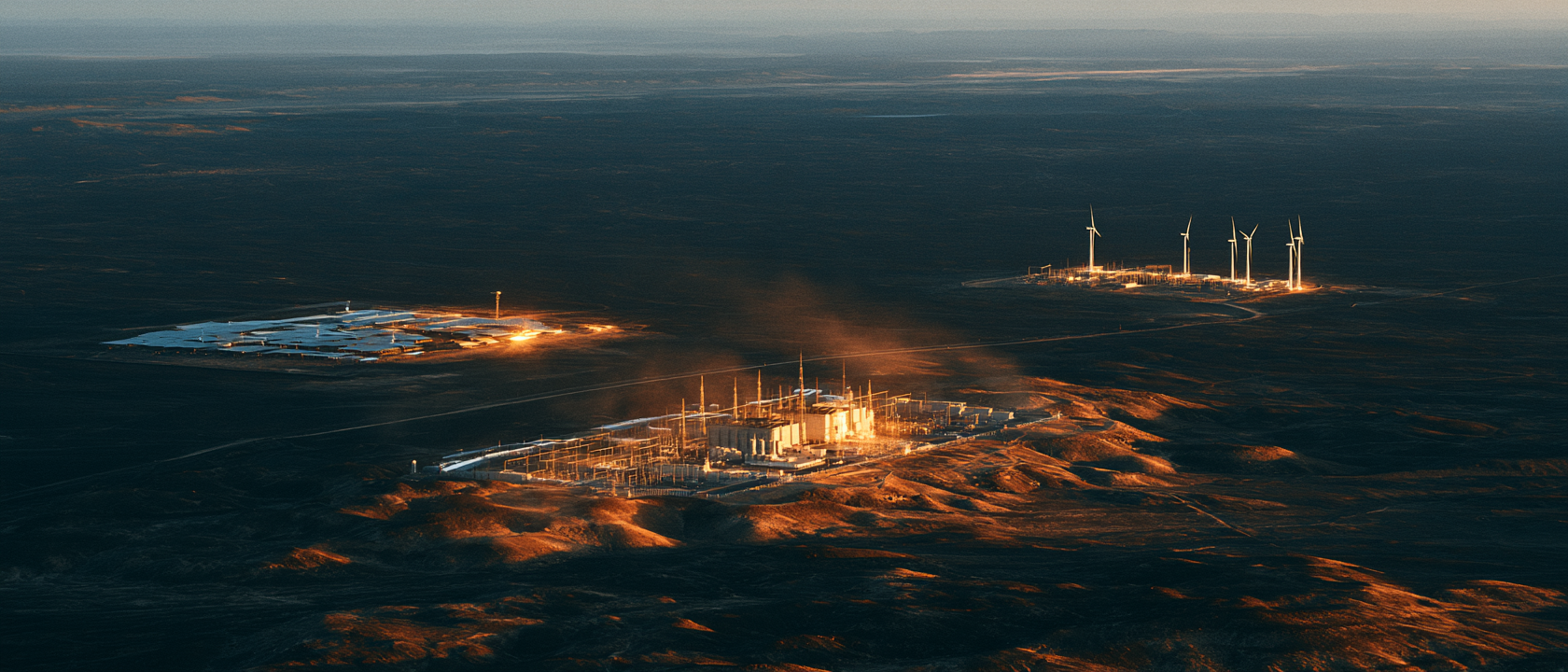
Solar capacity approached 9.6 gigawatts by the end of 2024 and kept climbing through 2025. Wind capacity crossed 6 gigawatts in the first half of 2026. Installed renewable capacity nationally now sits close to 18 gigawatts, with more than 110 gigawatts of additional projects in the licensing pipeline behind it.

That backlog cuts both ways. A pipeline that large signals real investor appetite, but it is also a queue, and queues mean permitting delays and grid connection dates that slip further out each year.
The same abundance that creates the advantage also creates the bottleneck. Early movers plan around that bottleneck. Everyone else discovers it the hard way, usually at the exact moment they need capacity fastest.
None of that, by itself, is a business advantage.
Abundant sun and wind are inputs. What turns them into positioning is what a company does with the fact that it operates inside that abundance, and most companies make little use of it.
They let the resource sit in the background: a fact about where they’re based, rather than something built into how they compete.
Plenty of countries have comparable resource abundance and little to show for it in how their companies compete internationally.
Resource alone rarely travels into a boardroom or a term sheet on its own. It has to be converted, and conversion is the part few companies budget for.
Funding and Infrastructure turn Geology into Geography
Two other pieces have to be in place before resource abundance becomes something a company can actually use.
The first is capital. Greece’s national recovery plan, worth close to €36 billion in EU grants and loans, has committed roughly 38%of that funding to green transition measures as one of its central pillars, not a side program attached to it.
That is public money underwriting private balance sheets, and it has already pulled forward the economics of grid upgrades, storage, and renewables permitting by years.
The second is geography turned into infrastructure. Greece is completing or building electricity interconnectors to Bulgaria, Cyprus, Israel, and Egypt, positioning itself as a transmission point between the Eastern Mediterranean and the rest of the European grid.
The Great Sea Interconnector alone carries around €657 million in EU funding. A separate project under development with Egypt is designed to move renewable power northward at a scale of up to 3,000 megawatts.
None of this generates a single watt of electricity on its own. What it does is turn Greece’s location into a role: a route other people’s power has to travel through, not just a source of it.
Resource, capital, and infrastructure together are the raw material. What a company builds with that raw material is a choice, and that choice is where positioning actually starts.

From Structural Advantage to Business Argument
A location advantage converts into positioning through four levers, and none require new technology or expertise.
The first is differentiation. A manufacturer or shipping company operating out of a country generating a rising share of its electricity from renewables, with falling exposure to imported gas price shocks, has a real cost and resilience storyto tell customers who are themselves under pressure to document their own supply chain emissions.
That is a logistics argument as much as a green one, and logistics arguments tend to survive scrutiny better.
The second is partnership. Interconnector infrastructure creates counterparties that did not exist a decade ago. A Greek company with grid, storage, or engineering capability now has a plausible reason to sit across the table from Egyptian solar developers, Balkan utilities, and EU infrastructure financiers.
That seat comes from the transmission map, not from a business development plan.
The third is the investor narrative. In our previous CEO Foresight article, we noted that companies earning more than half their revenue from green markets are commanding valuation premiums of 12 to 15%.
A company operating from inside a market with genuine renewable abundance and improving grid access can back that green revenue claim with something more concrete than intention. It can point to falling energy costs, secured interconnection capacity, and public co-financing, and show the premium is grounded in something real rather than aspirational.
The fourth is supply chain resilience, which increasingly matters to customers more than the sustainability language wrapped around it.
A company whose energy costs are stabilizing while its neighbors remain exposed to imported fossil fuel at spot prices has a reliability argument that holds up under scrutiny in a way marketing language rarely does.

What Makes a Shared Advantage Competitive
None of these four levers are exclusive to Greece. Any company with a structural advantage of its own can use them the same way, wherever that happens to be.
A business in Vietnam operating inside a growing offshore wind corridor, a company in Chile building a green hydrogen export business on some of the world’s strongest solar resource, and a manufacturer in Kenya tied into East Africa’s regional power grid through its geothermal base: each carries a version of the same underlying advantage Greece has.
The advantage itself isn’t owned by any single company, either. Every business based in the same country draws on comparable energy costs, funding access, and infrastructure underway.
What turns a shared national advantage into a competitive one is who claims it firstand clearly enough for a customer, a partner, or an investor to act on.
Moving early tends to shape what follows: which company becomes the preferred partner, which financing offer arrives first, which contract gets signed before a rival can make the same case.
The question by now isn’t whether this advantage exists. It’s whether anyone inside the company holds the authority, and the accountability, to turn it into the differentiation story, the partnership conversation, the investor narrative, or the resilience case.
A competitor drawing on the same advantage is asking that question too. Which one of you answers it first?
SOURCES
1. European Parliament, EPRS Briefing, “Greece’s National Recovery and Resilience Plan: Latest state of play”, June 2025 — https://www.europarl.europa.eu/thinktank/en/document/EPRS_BRI(2022)729366
2. IPTO, “Great Sea Interconnector” (project page) — https://www.great-sea-interconnector.com/en
3. European Commission International Partnerships, “GREGY — High Voltage Electrical Interconnection in the Eastern Mediterranean” — https://international-partnerships.ec.europa.eu/policies/global-gateway/gregy-high-voltage-electrical-interconnection-eastern-mediterranean_en
4. Athens Times, “Wind & Solar Rules in Greece: New Spatial Framework”, May 2026 — https://athens-times.com/wind-farms-and-solar-parks-what-the-new-spatial-framework-sets-for-their-placement-and-market-stakeholders-concerns/
5. Renewables Now, “Greece’s wind energy capacity exceeds 6 GW”, July 2026 — https://renewablesnow.com/news/greeces-wind-energy-capacity-exceeds-6-gw-1297775/
6. RatedPower, “The role of solar in decarbonizing Greece’s energy grid”, October 2025 — https://ratedpower.com/blog/solar-decarbonizing-greece/
7. World Economic Forum, “The Multi-Trillion Dollar Growth Opportunity”, December 2025 (carried over from Part 1, for the 12–15% valuation premium figure) — https://www.weforum.org/press/2025/12/the-multi-trillion-dollar-growth-opportunity-new-report-shows-green-economy-expected-to-surpass-7-trillion-in-annual-value-by-2030/
8. ESMAP (World Bank), “A Framework for Private Sector-Led Offshore Wind Projects in Viet Nam” — https://www.esmap.org/OffshoreWind_Vietnam_Framework
9. Baker Institute, “Paving the Road for Competitive Green Hydrogen Hubs: Does Chile Have a Chance?” — https://www.bakerinstitute.org/research/paving-road-competitive-green-hydrogen-hubs-does-chile-have-chance
10. African Business, “Why Kenya is buying more electricity from Ethiopia”, June 2026 — https://african.business/2026/06/energy-resources/why-kenya-is-buying-more-electricity-from-ethiopia
11. Eastern Africa Power Pool, official site (Kenya’s EAPP membership context) — https://eappool.org/