

Most executives have not been ignoring geopolitics.
They have been operating on assumptions of relative stability that, for decades, were entirely justified.
The foundations those assumptions were built on have shifted. Most strategies have not caught up.
A structural shift, not a turbulent cycle
Senior leaders are skilled at managing disruption: a market downturn, a regulatory overhaul, a competitor that moves faster than expected. These are challenges within a system that remains fundamentally stable. That stability was taken as a given.
It no longer is.
Multiple conflicts across Europe and the Middle East have simultaneously disrupted energy pricing, shipping routes, and trade flows that companies spent decades optimizing. Supply chains built on economic logic are being re-routed for political reasons.
Energy corridors that seemed settled are now subject to active competition. These are not isolated shocks that correct over time. They are signals that the underlying order has changed.
Aon’s 2025 Global Risk Management Survey, drawing on nearly 3,000 C-suite leaders across 63 countries, found that geopolitical volatility broke into the global top ten business risks for the first time in the survey’s 19-year history, rising 12 places since 2023. Only a third of organizations feel prepared for it, despite 37% having already reported losses from geopolitical exposure in the prior 12 months.
Two thirds of organizations are carrying a risk they have not yet built a plan for.
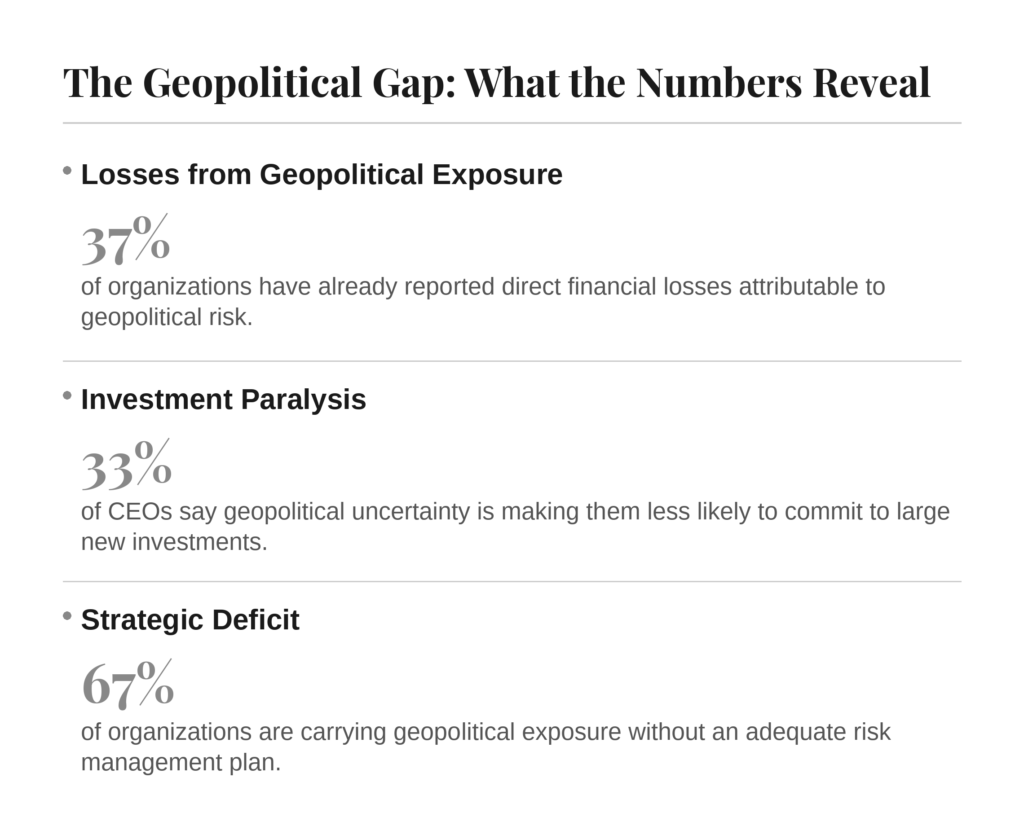
PwC’s 2025 Global CEO Survey adds a sharper finding: a third of CEOs say geopolitical uncertainty is already making them less likely to commit to large new investments. This is not an anticipated future problem. It is shaping capital allocation decisions today.
Size and distance are not the protection they once were
Geopolitical risk does not require proximity to an unstable region to reach a business. It travels through supply chains, financing conditions, and the decisions your largest customers are making based on their own exposure.
This matters for mid-sized companies as much as multinationals. The channel through which the risk arrives may be indirect. The impact on margins, investment capacity, and planning assumptions is not.
A manufacturer whose key supplies have been re-routed for political reasons is carrying geopolitical exposure, whether or not they have labeled it as such. A company seeking financing in a market that is quietly repricing regional risk into its lending decisions will feel the effect long before they see the cause.
If your largest clients are navigating their own geopolitical exposure, some of that uncertainty will find its way into your pipeline.
The risk does not announce itself. That is what makes it harder to manage than the disruptions organizations have built processes to handle.
Greece at the crossroads: opportunity, exposure, and the gap between them
The Eastern Mediterranean is where these pressures become concentrated. Energy competition, regional conflict, trade route disruption, and the active repositioning of major powers are no longer separate forces. They are colliding here, simultaneously.
Greece sits inside this convergence.
The forces shaping its business environment are no longer primarily domestic or even regional. They are geopolitical in origin, and they arrive through different channels depending on the industry, the supply chain, and the decisions being made upstream by customers, suppliers, and financiers.
The risk side of this is already visible.
Greek shipping, one of the country’s most significant economic engines, has felt the direct consequences of disruptions to critical global corridors, with re-routing forcing cost and timeline adjustments across the industry. Tourism, acutely sensitive to regional stability perceptions, absorbs the reputational effect of tensions it did not create. The energy sector sits at the intersection of opportunity and exposure simultaneously.
That last point matters. The significant investment flowing into Greek energy infrastructure from major American companies is not happening despite the regional instability. It is happening because of it. Europe’s need to replace Russian energy supply created a strategic imperative, and Greece’s geography made it a viable corridor.
The investment followed the geopolitical logic, not the other way around.
Greek executives have long operated in a complicated neighborhood, treating the friction that comes with it as background noise: something to monitor and factor into certain decisions, but not something that demanded a fundamental strategic response.
What has changed is not the existence of complexity but its nature. The forces now in play are reshaping market access, investment geography, supply chain structures, and long-term positioning in ways that reactive management cannot address.
The background noise has become the main event. And the strategies that were built for a different world have not yet registered that.
From awareness to architecture
Organizations that have felt geopolitical pressure in recent years have largely responded the same way: they managed the immediate disruption, adjusted where necessary, and returned to the plan. That is not a failure of judgment. It is what good operational management looks like.
The problem is that it treats a structural shift as an episodic one. Each disruption gets handled. The underlying exposure never gets addressed.
Building a structured approach means mapping where the exposure actually lives: across supply chains, markets, financing structures, and customer dependencies. It means stress testing strategic assumptions against geopolitical scenarios, not just financial ones, and making deliberate decisions about where to invest and what risks to carry consciously rather than accidentally.
The capability exists. What has been missing is the decision to give geopolitical risk the same planning weight as financial or operational risk.
Every strategy rests on assumptions that are rarely examined. When did you last examine yours?
In two weeks, we move from diagnosis to framework: how to map your exposure and build geopolitical risk into your planning before the next disruption does it for you.
Sources
[1] Aon Global Risk Management Survey, 2025 — https://www.aon.com/en/insights/reports/global-risk-management-survey/geopolitical-volatility-preparing-for-the-unpredictable
[2] PwC 29th Annual Global CEO Survey, 2025 — https://www.pwc.com/gx/en/issues/c-suite-insights/ceo-survey.html
[3] Tovima: US Backs Greece as Key Energy Hub, November 2025 — https://www.tovima.com/politics/us-backs-greece-as-key-energy-hub-in-east-mediterranean/amp/
[4] Cyprus Mail: Greece Poised to Become Energy Gateway, June 2026 — https://cyprus-mail.com/2026/06/01/greece-is-poised-to-become-energy-gateway-for-southeast-europe-and-the-east-med
This article was originally published in The CEO Foresight, the LinkedIn Newsletter of CEO Clubs Greece.